Sprint Mechanics: The Secret of
Speed
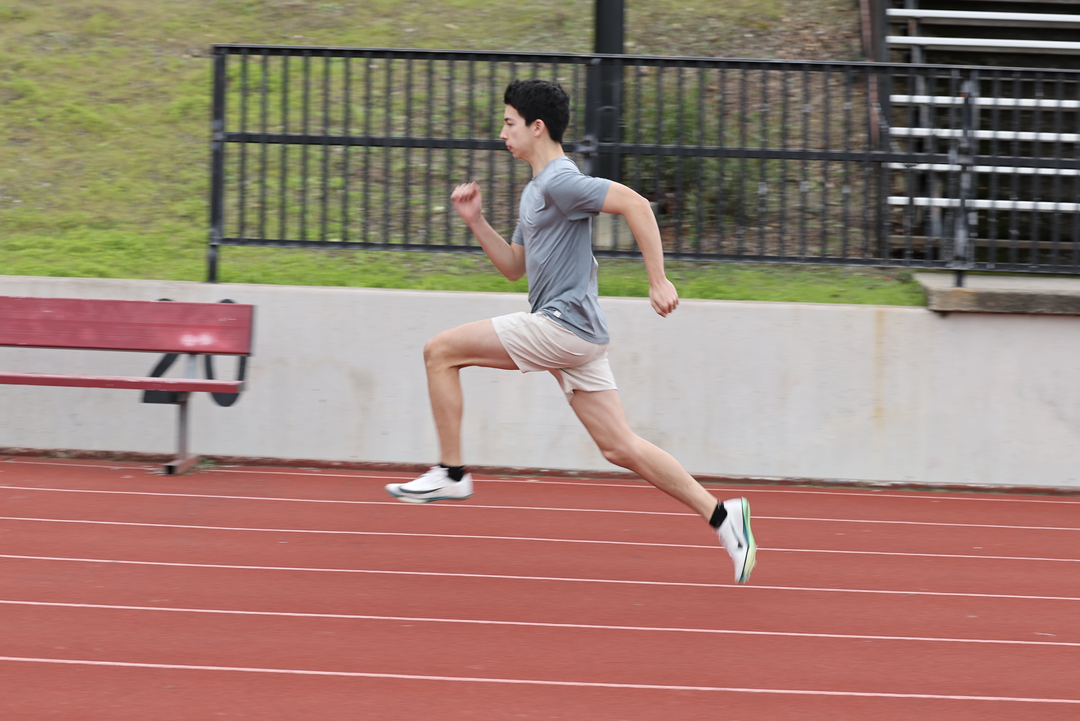
Speed Is Smooth
The biggest mistake I see on the track is "frantic flailing." An athlete wants to go faster, so they try to move their legs faster or reach further. It looks busy, it feels awful, and it’s almost always slower.
When you watch the best in the world, they look eerily calm. That’s because sprinting isn't a competition rewarding who can move their legs through the air the quickest. It’s a contest of who can deal with the ground most effectively.
True speed happens fast. At top speed, your foot is on the ground for less than a tenth of a second. In that instant, you’re trying to hit the track with several times your bodyweight. There’s no time to grind or adjust -- whatever force you’re going to apply has to show up immediately.
The Physics of the "Punch"
Looking at the research done by Peter Weyand and his team, it becomes clear that elite speed isn't about cadence. Most fast sprinters have a similar "step frequency." The difference is that the faster runners cover more ground per stride because they’re better at producing impulse.
Formally, sprinting is governed by the impulse-momentum relationship:
J = ∫ F(t) dt
In simple terms, the "area under the force-time curve" during ground contact determines how much momentum you gain each step. Because the ground contact time is so incredibly short at max velocity, an athlete cannot rely on grinding out a rep like they would in a heavy squat. You have to reach a massive peak force almost instantly. If you take too long to produce that force, your contact time increases, your center of mass drops, and you essentially "bleed" velocity. As a coach might cue, "Don't push the ground! Smack it!"
Ken Clark has written extensively on this, showing that elite sprinters hit the ground hardest in the first half of the contact phase. They aren't pushing back; they’re striking underneath. And if your foot lands too far in front of your center of mass, you’re basically hitting the brakes. You have to overcome that "braking impulse" before you can even start moving forward again.
Posture is the Secret Weapon
Coaches are always yelling about "staying tall" or "keeping your hips up," but it’s not just for aesthetics. It’s about energy leaks.
Think of your leg as a stiff metal spring. If your pelvis tilts or your torso collapses, that spring turns into a pool noodle. You lose energy. Your contact time gets longer, you start "sitting" in your stride, and your speed dies. When you stay stacked and rigid, that force goes directly into the track and propels you forward.
This is where "frontside mechanics" actually come from. You don’t force your knees up. When you strike the ground hard with a stable torso, the leg tends to recover forward on its own. Miss the posture, miss the timing, or miss the strike -- and all the cueing in the world won’t fix it.
Training Speed
Speed is a nervous system quality, not a cardio one. Training for speed is about quality and intent, not volume.
- Fly Sprints: These are the gold standard. Take 30 meters to build up, then hold your absolute top speed for 20 meters. Stop as soon as you get "tight" or "frantic".
- Hurdle Hops: The goal here is to maximize your Reactive Strength Index (RSI) -- the ratio of how high you fly to how little time you spend on the ground. We're forcing the Achilles tendon to transition rapidly from loading to explosion.
- Pogos: We use short, rhythmic jumps (pogos) to train the ankles to be stiff. If your heels touch the ground or your ankles feel "squishy," you're not doing it right.
- Max Strength: Research from Nagahara and JB Morin suggests that while we need force, we need it in the right direction. Use heavy isometrics (like a mid-thigh pull) to teach your brain to recruit muscle without the "slow" movement of a traditional heavy squat.
The Bottom Line
Sprinting is just a physics problem solved under extreme time pressure. The goal isn't to work harder; it's to be more efficient. Less time on the ground, less wasted motion, and more forward propulsion.
When you stop trying to "run fast" and start focusing on "hitting the ground right," you'll find that effortless, flowing speed.
Key Technical References
- Weyand, P. G., et al. (2000). Journal of Applied Physiology. Proved that ground force, not leg turnover, is the primary driver of top speed.
- Clark, K. P., & Weyand, P. G. (2014). Journal of Applied Physiology. Identified the "Force Signature" of elite vs. non-elite runners.
- Morin, J. B., & Samozino, P. (2016). Scandinavian Journal of Medicine & Science in Sports. Introduced the "Force-Velocity-Power" profiling that we use to balance training.
- Nagahara, R., et al. (2018). Journal of Applied Biomechanics. Detailed how ground reaction forces evolve as an athlete moves from acceleration to max velocity.